Showing posts with label Mac books. Show all posts

Thursday, 21 July 2011

Apple launches new 27-inch Thunderbolt Display, Mac mini

Coinciding with the launch of Mac OS X Lion and the revamped MacBook Air, Apple has unleashed a new high-resolution display and Mac mini, both of which advance Apple's adoption of Thunderbolt connectivity (formerly known as Light Peak). Set to ship in the next 60 days, the 27-inch Thunderbolt Display is billed as the "ultimate docking station" for Mac notebooks as the display can use one Thunderbolt cable to transmit power and visuals, or to daisy chain up to five additional external devices.

The Thunderbolt Display sports an LED-backlit IPS panel that touts a resolution of 2560x1440 and 178-degree viewing angles. It's also outfitted with an ambient light sensor that tweaks the brightness based on external lighting conditions, a built-in "FaceTime HD" webcam and mic, a 2.1 speaker system, as well as an integrated MagSafe charger to keep MacBooks charged. Aside from Thunderbolt, connectivity includes three USB 2.0 ports, one FireWire 800 port, and Gigabit Ethernet. Pricing is set at $999.


Meanwhile, the new Mac mini crams more speed and functionality in the same compact aluminum body as its predecessors. Three base configurations are available starting at $599, which gets you a 2.3GHz dual-core Intel Core i5, 2GB of DDR3 1333MHz RAM, and a 500GB 5400RPM HDD. For $799, that's upgraded to a 2.5GHz dual-core Core i5, 4GB of RAM, and an AMD Radeon HD 6630M graphics chip. A third, server-oriented system wields a 2GHz quad-core i7 and dual 500GB 7200RPM HDDs for $999.

If desired, the two non-server configurations can be equipped with a 2.7GHz Core i7, 8GB of RAM, a 750GB HDD or 256GB SSD (or both), which pushes the fee north of $1,800. All systems come with a Thunderbolt port, four USB 2.0 ports, a FireWire 800 port, an HDMI port, an SDXC card slot, Gigabit Ethernet, 802.11n, Bluetooth 4.0, audio jacks, as well as a built-in power supply and speaker system. Mac OS X Lion is preinstalled on the dual-core models, while the quad-core server build gets Lion Server.

Thank you :
http://www.techspot.com/news/44771-apple-launches-new-27-inch-thunderbolt-display-mac-mini.html

Why Apple killed off the white MacBook


When Apple refreshed its line of MacBook Airs and Mac minis today, the company also quietly removed its $999 13-inch white MacBook from its store. Now the least expensive MacBook that Apple offers is the updated $999 11.6-inch MacBook Air.

Unfortunately, the two items are not as alike as you might think. Not only do you get less screen real estate with the Air, you also get a lot less hard drive space with only 64GB on the $999 Air’s SSD drive. But the Air makes up for this with more powerful performance, a backlit keyboard, and a lighter design with an aluminum chassis. Since the products have different audiences in mind and fulfill different needs, it seems a little curious that Apple would shutter the white MacBook.

But Michael Gartenberg, technology analyst for Gartner, isn’t surprised. He thinks the strategy is to reduce the number of products Apple has in its lineup while still offering a laptop for less than $1000.

“Given the appeal of the new MacBook Air, with better specs and a much more appealing design, I’m not surprised that Apple decided to retire the MacBook as an entry-level machine,” Gartenberg told VentureBeat. “Ever since the new Airs were introduced at the same price point, it was likely many consumers were choosing the Air over the MacBook.”

I’d venture another reason: the iPad. Apple’s staggering third quarter iPad sales indicate that many consumers are willing to sacrifice some of the better aspects of a laptop for the ease and accessibility of a tablet. I even know a few casual users who use their iPads entirely as a primary device.

Now that Apple has the iPad available at a base price of $499 and the MacBook Air available at a base $999 price, the company surprisingly has most of its consumer bases covered, and people can spend a little more if they want to upgrade from that level. And let’s not forget that Apple could easily release more products this year or next to continue hitting each level of consumer.

What do you think of Apple’s decision to kill off the white MacBook? Are you interested in the $999 MacBook Air?

Thank you :
http://venturebeat.com/2011/07/20/why-apple-killed-off-the-white-macbook/

Sunday, 3 July 2011

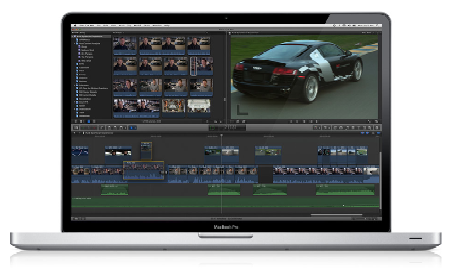
Why Apple built Final Cut Pro X


I worked on Final Cut Pro from 2002 to 2008. It was an amazing experience. The Final Cut Pro X project was just getting started when I left Apple. It was an ambitious and controversial move, but it made sense for Apple. Here's why:

Apple doesn't care about the pro space
The goal for every Apple software product is to sell more hardware. Even the Mac operating system is just trying to get people to buy more Mac computers.

The pro market is too small for Apple to care about it. Instead of trying to get hundreds or even thousands of video professionals to buy new Macs, they can nail the pro-sumer market and sell to hundreds of thousands of hobbyists like me.

Millions of people are buying phones and cameras that can shoot HD video, and many of them are looking for ways to edit. I know how to use Final Cut Pro because I worked on it for 6 years, but for most people it's just too complex.

Apple doesn't compete on features
In the early days of Final Cut Pro, the product stood on its own. It was the first truly powerful, software based non linear editor.

Editors had two choices: spend $50k on an Avid system, or $1k on a Final Cut Pro license. You couldn't compare the two on features because the experiences and price points were vastly different. Every seat FCP won away from Avid was a huge victory.

But things changed in 2006 and 2007. Serious competitors to Final Cut Pro came from Adobe, Pinnacle, Sony, and others. People were choosing their hardware and software based on format support, or specific features they needed.

That's boring. Apple doesn't play that game.

So it was time to reinvent the video editor. And Final Cut Pro X really delivers there. FCPX isn't defined by a feature chart. It's not trying to do more than its competitors, it's doing it better.

And once again, Final Cut Pro stands on its own. And once again, Final Cut Pro willexpand the market of video editors out there, and I'll be one of them.

Final Cut Pro 1.0 didn't win over every Avid user, and Final Cut Pro X won't win over every Final Cut Pro user. But they've laid the foundation for something incredible, and I can't wait to see where it goes from here.

Congrats to all my friends on the Final Cut Pro team who shipped this incredible release!